

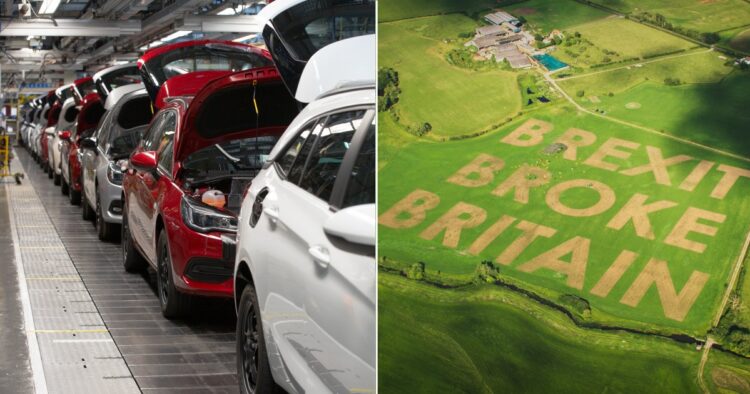
Brexit was supposed to unleash Britain’s economic potential. Instead, the decision to leave the European Union has created fresh obstacles for one of the country’s most important manufacturing industries.
In 2016, the UK had built up a car manufacturing industry that rivalled Germany. Then, Britain decided to commit what London Mayor Sadiq Khan has labelled the greatest act of economic self-harm in our country’s history.
After Brexit, British car production fell from around 1.7 million vehicles in 2016 to just 717,371 last year, according to the Society of Motor Manufacturers and Traders (SMMT).
While Brexit is not solely responsible for the decline, leaving the EU has made life considerably harder for manufacturers already grappling with global economic pressures.
Look at how the decline in Britain compares to Germany. In Germany, output over the same time period fell from 5.75 million to 4.15 million. This is a drop of just over a quarter – Britain’s output fell by almost three-fifths, as reported by UK in a Changing Europe.
Before 2016, manufacturers in Britain benefited from frictionless access to the European single market and customs union. Today, businesses face additional customs formalities, paperwork and administrative costs when trading with their largest nearby market.
That matters enormously in an industry built around complex international supply chains. Components routinely cross borders before vehicles are assembled, with manufacturers relying on deliveries arriving precisely when they are needed. Additional bureaucracy and the risk of delays undermine the efficiency that made British factories competitive.
The uncertainty surrounding Brexit also threatened investment at a critical moment. Manufacturers were deciding where to build their next generation of vehicles, batteries and electric vehicle components, while Britain’s future trading relationship with Europe remained unresolved.
The consequences are particularly concerning as the industry transitions towards electric vehicles. Under the UK-EU trade agreement, rules governing where vehicle and battery components originate could expose some electric vehicles to tariffs if they fail to meet the requirements for tariff-free trade. Tougher rules scheduled for 2027 have created further uncertainty for manufacturers planning their supply chains.
The industry’s own trade body has been blunt about the consequences. Its 2025 trade report found that UK-EU automotive trade has generally underperformed compared with trade with the rest of the world, highlighting how the new trading relationship has affected the sector.
Of course, Brexit is not the only problem. The pandemic, semiconductor shortages, fierce international competition and the transition to electric vehicles have all contributed to falling production.
But Brexit was the only obstacle that Britain deliberately put in its own way.
Britain chose to introduce new barriers with its most important automotive trading partner just as the global industry was undergoing a historic transformation.
Rather than liberating British carmakers, Brexit has saddled them with additional costs, uncertainty and disadvantages their European competitors do not face when trading within the single market.
For an industry that depends on investment, efficiency and international cooperation, that is a disastrous own goal.