

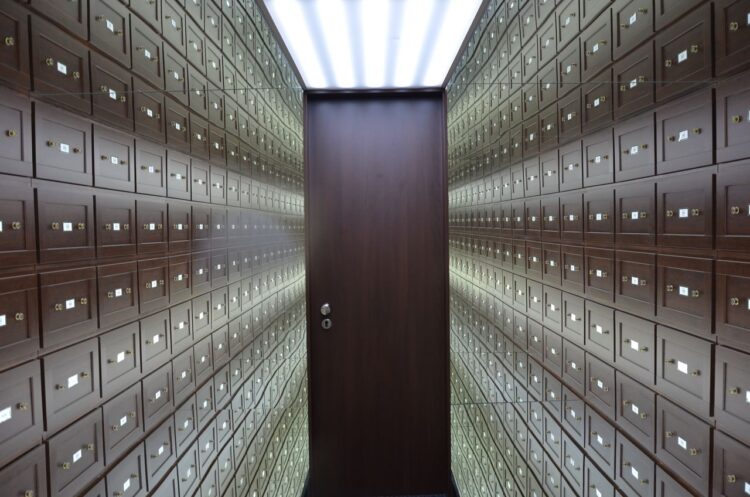
That arrangement has largely disappeared. Over the past two decades, Britain’s big high street banks have closed their safe deposit services or stopped taking new customers, leaving families to work out for themselves where the things that matter most should live.
A quiet withdrawal
The retreat happened gradually, which is partly why it attracted so little attention. Banks cited cost, staffing and the reputational risk of being responsible for customers’ valuables. Branch closures did the rest.
The same shift has played out in other countries, and the response has been similar. Where banks stepped back, private vault operators stepped in. In New Zealand, for example, providers such as Commonwealth Vault Safety Boxes run dedicated vault facilities rather than offering boxes as a sideline to everyday banking.
That model is now common in the UK as well, with independent safe deposit centres opening in London and other cities.
Why banks lost interest
From a bank’s point of view, safe deposit boxes were never a money-spinner. The fees charged rarely covered the cost of the vault space, the staff time needed to supervise access and the security required to protect it.
As branches shrank and staffing was cut back, a service that required a member of staff to accompany each visit became harder to justify. Many branches simply no longer had the people or the space.
There was also the question of liability. A bank holding customers’ valuables carries the risk of being blamed if anything goes wrong, and for a service that earned little, that risk was increasingly seen as not worth carrying.
The result was a slow retreat. Some banks closed boxes branch by branch, others stopped accepting new customers, and existing holders were eventually asked to empty their boxes and find somewhere else.
What the banks left behind
Consumer group Which? has reported that almost all major high street banks have stopped providing safe deposit boxes, and that independent firms have sprung up around the country to fill the gap.
For customers, that has meant a choice they never used to face. Some moved their boxes to private providers. Others took everything home, often to a cupboard or a drawer rather than a proper safe.
Neither choice is wrong in itself, but the second carries risks that are easy to overlook until something goes missing.
The problem with keeping it at home
Most people’s valuables are not obviously valuable. A box of old jewellery, a watch inherited from a parent, a folder of property documents or a handful of coins does not look like much, which is exactly why it ends up in a bedside drawer.
That makes it vulnerable in a few ways:
- burglary, where small, portable items are the first things taken
- fire and flood, which can destroy paper documents in minutes
- simple loss, when items are moved during a house move or clear-out
- family uncertainty, when nobody knows where important papers are kept
Insurance can cover some of the financial loss, but not the sentimental value of a wedding ring or a letter from a grandparent.
What people actually store
The contents of a typical safe deposit box are more ordinary than the films suggest. Original wills and property deeds remain common, alongside birth and marriage certificates, share certificates and passports that are not in regular use.
Jewellery is the other big category, particularly pieces worn only on special occasions. Watches, coins, small amounts of precious metal and items of family history such as medals and letters often join them.
The common thread is that these are things people do not need every day but would be devastated to lose.
Choosing a private provider
With banks largely out of the picture, choosing where to store valuables now means looking at independent providers. A few questions are worth asking before signing up:
How is access controlled, and who else can open the vault? What are the opening hours, and can you visit at short notice? Is there insurance included, and what does it cover? What happens if you need to end the arrangement?
A reputable provider will answer these clearly and in writing. It is also worth visiting the facility in person before committing, since the way a vault is run tells you a lot about how seriously it takes security.
A wider shift in how we hold wealth
The decline of the bank safe deposit box is part of a broader change. Banking has moved online, branches have closed and fewer people keep anything physical with their bank at all.
Yet the need for secure physical storage has not gone away. If anything, the rise of digital banking has made the few physical things people do own feel more precious, from family heirlooms to the paperwork that proves who owns what.
That tension explains why private vaults have grown even as bank vaults have closed. People still want somewhere safe, separate and permanent for the things that cannot be replaced.
Getting organised
Whether valuables end up in a private vault or a good home safe, a little organisation makes a big difference. Keep a list of what you hold and where it is. Tell a trusted family member or executor where to find it. Make copies of important documents and store them separately from the originals.
Those simple steps protect against the most common problem of all, which is not theft or fire but families who simply do not know where things are when they are needed most.
The end of an era, not the end of the need
The bank safe deposit box may be fading from British life, but the reasons people used it have not changed. Families still have things worth protecting, and the question of where to keep them is now one they have to answer for themselves.
For many, the answer is to look beyond the high street and choose a provider whose whole business is keeping things safe. The sooner that decision is made, the less likely it is that something precious is lost in the meantime.