

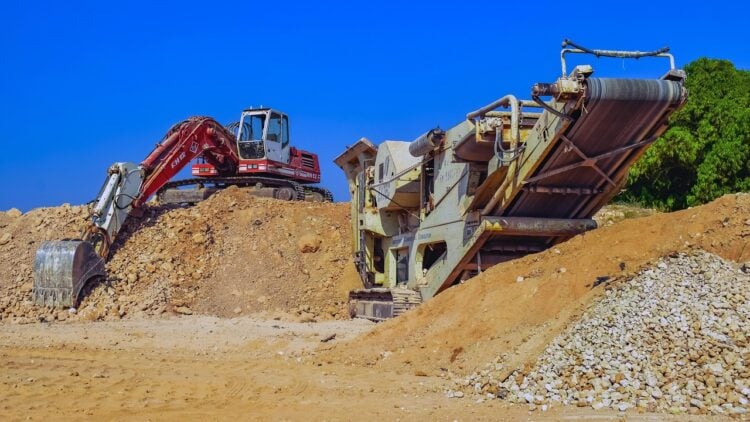
Crushers, screeners, washers and conveyors all come in both forms, and the right answer depends far more on how you work than on the machines themselves. Here is how to weigh it up.
What Sets Static and Mobile Equipment Apart
Mobile plant is built to travel. Tracked and wheeled units can be driven onto a low loader, moved between sites and set up in hours rather than weeks. They are self contained, which suits contractors and operators who follow the work from place to place.
Static plant stays put. It is installed as a fixed line, often bolted to a concrete base and wired into a permanent power supply. Once it is in place it processes very high volumes day after day, which makes it the natural choice for a long running quarry or a fixed recycling yard. Washing setups in particular are often built as static or modular plants, since they tie into water management and settlement systems that do not move easily.
When Mobile Aggregate Equipment Makes Sense
Mobile equipment earns its keep when the work moves. If you run contracts across several sites, a mobile crushing plant lets you turn up, process material where it sits and move on without leaving anything behind. That cuts haulage, since you are not carting raw material back to a central plant, and it keeps you flexible when one job ends and the next begins somewhere else.
It also suits shorter projects and on site recycling. Demolition and construction firms often crush and screen rubble where it falls, turning waste into reusable material without the cost of a permanent installation. Setup is quick, groundworks are minimal, and you can hand the site back as you found it. For anyone whose workload changes month to month, that flexibility is hard to beat.
When Static Aggregate Equipment Makes Sense
Static plant comes into its own where the work stays in one place and the tonnage is high. A quarry feeding the same line for years will get more out of a fixed installation, which runs continuously and handles far greater volumes than a mobile unit. Because the plant is purpose built around your material and output, throughput stays steady and the cost per tonne usually drops once you are processing at scale.
Static lines also handle complex, multi stage setups better. A full washing and screening operation, with scrubbers, rinsing screens, sand plants and conveyors all linked together, is easier to run as a fixed plant than to assemble from separate mobile machines. If your process is settled and your site is permanent, static equipment tends to pay back the larger upfront outlay over time.
Questions That Point You One Way or the Other
A few honest answers usually make the choice clearer.
- How often do you move between sites, and how quickly do you need to be running once you arrive?
- How many tonnes a year are you processing, and is that volume steady or seasonal?
- Is the site permanent, or will the work move on within a year or two?
- How much space do you have, and what groundworks or power supply can you put in?
- Do you need a single machine, or a full multi stage line working as one?
The more your work moves and varies, the stronger the case for mobile. The more settled and high volume it is, the more static stacks up.
Matching the Format to the Machine
The static or mobile question plays out a little differently across each type of equipment.
Crushers
Mobile jaw, cone and impact crushers suit primary work on changing sites and recycling jobs, while static crushing lines deliver heavy, continuous reduction for fixed quarry operations. Many operators run a mobile crusher for flexibility and a static one for bulk throughput.
Screeners
Screening follows the same pattern. Mobile and portable screens move easily and set up fast, which helps on smaller or short term sites. Static inclined and horizontal screens handle large, consistent volumes as part of a fixed plant.
Washers
Aggregate washing leans towards static and modular plants, because scrubbing, rinsing and sand recovery work best when tied into a permanent water and settlement system. Mobile rinsers do exist for lighter or temporary jobs, but high volume washing usually wants a fixed setup.
Conveyors and Feeders
Conveyors and feeders bridge both worlds. Mobile stackers move with the rest of a tracked fleet, while fixed conveyors and feeders link the stages of a static plant into one flow. The right mix depends on how the rest of your line is built.
You Do Not Always Have to Pick One
Plenty of operations run both. A common setup uses a mobile crusher to break material down on site, then feeds it into a static screening or washing plant for finishing. That blend gives you the reach of mobile kit at the front end and the volume of static plant where it counts. The point is to match each machine to the job rather than commit the whole site to one format.
Getting the Right Setup for Your Site
There is no single right answer, only the one that fits how you work. Start with how much you move, how much you process and how permanent the site is. From there, the balance between static and mobile usually settles itself.
If you are weighing up the options, it helps to talk it through with a supplier who works across both. PowerX Equipment supplies mobile, static and modular crushers, screeners, washers and conveyors, and can help you put together a setup built around your material, your volumes and the way your business runs.