

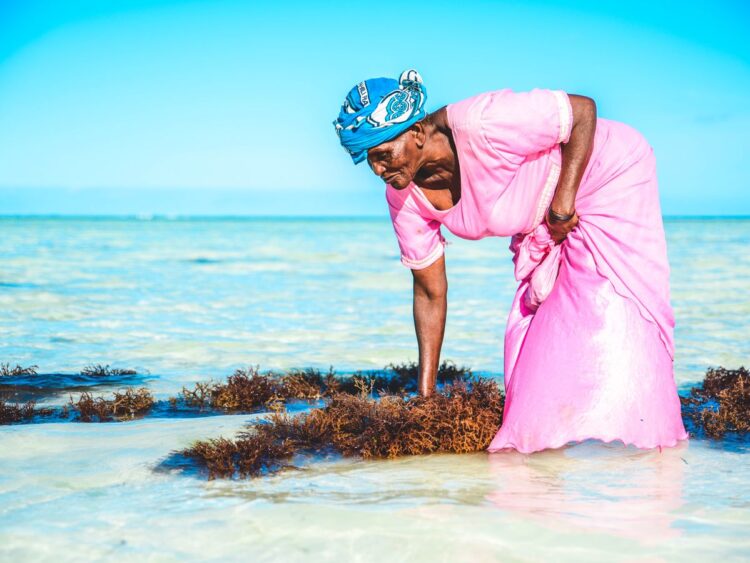
The Tanzania Investment Forum in London this month concluded with several major announcements, including the return of direct British Airways flights to Kilimanjaro and Zanzibar, as well as plans for Tanzania to surpass China in global graphite production. Yet one declaration may have left some attendees scratching their heads: a goal for Tanzania to capture more value from seaweed.
The announcement was made by Zahor Kassim El-Kharousy, deputy permanent secretary at the Ministry of Blue Economy and Fisheries. At present, Tanzania grows around 90% of the seaweed produced in Africa, yet almost none of it is processed at home.
Tanzania has already committed to massively bolstering its blue economy, which presently makes up about 12% of the country’s GDP and supports around five million jobs. Under President Samia Suluhu Hassan’s Vision 2050 agenda, the blue economy – encapsulating everything from fishing and tourism to offshore oil and gas – will contribute between $40 billion and $50 billion to national output, or 20% of GDP.
Of all the goods and commodities which Tanzania produces and exports, from gold to graphite to bananas, cashew nuts, coffee and tobacco, seaweed does not seem an obvious engine of economic growth, but El Kharousy calls it “a magic commodity”.
Most of Tanzania’s crop is red seaweed, dried and shipped abroad to be turned into carrageenan, a natural thickener found in ice cream, toothpaste and cosmetics. Seaweed is also used in pharmaceuticals, fertiliser and as an alternative to plastic packaging. According to UN Trade and Development, seaweed is a reliable, low-carbon, healthy source of food considered an environmentally sustainable form of aquaculture, requiring no fertilisers, pesticides, land or freshwater.
The global seaweed market is worth approximately $16.7 billion and is dominated by East Asia. China alone produces around 12 million tonnes annually, capturing 65% of the global market, followed by Indonesia, the Philippines and South Korea. Tanzania may be Africa’s leading producer, but its share of the global market’s value is still small. Zanzibar, where most of the country’s seaweed is farmed, earned $7.1 million from seaweed exports in 2025.
Nevertheless, seaweed farming is an important industry for Tanzania’s coastal communities. It employs over 36,000 farmers, 80% of whom are women. The trade therefore provides vital financial independence, funding household needs, healthcare and education. Yet Zanzibar’s $7.1 million in annual seaweed export earnings is modest when set against the number of farmers who depend on the industry. Much of the potential value is lost because, as El Kharousy stated, “the problem is that we export 99% of our seaweed in raw form.”
A 2026 UN trade and development analysis found that 68% of seaweed’s export value came from processed products, even though they make up only 30% of export volume. In 2022, agar – a refined seaweed by-product often used in vegan and vegetarian cooking – traded at around $18.70 per kilogram, compared to $1.40 for unprocessed seaweed.
If Tanzania were able to process even 30% of its seaweed before export, in line with global averages, estimates suggest that its annual export earnings could rise to around $12–15 million without any increase in farming yields.
El Kharousy was clear about what needs to happen next: “Seaweed agriculture needs cold-storage facilities,” he told the forum. Without cold storage, harvests can deteriorate, forcing farmers to sell quickly at whatever price buyers offer. On processing, he said, “We are exploring how to diversify the product and export processed goods. We want to process seaweed into pharmaceutical products and edible materials.”
A survey of farmers on a Food and Agriculture Organisation training programme found that around 40% still dry their seaweed on the ground, which lowers the quality and price of the crop. The industry needs better infrastructure and investment to enable value addition. Investment has started to arrive, with the state-backed Zanzibar Seaweed Company fast-tracking the completion of a seaweed processing factory in North Pemba. The factory is now expected to become operational by December 2026 and will eventually enable the processing of more than 40,000 kg of raw seaweed a day into food and fertiliser.
The wider investment climate in Tanzania has also improved in recent years. The Tanzania Investment and Special Economic Zones Authority has proposed tax relief on boats, ropes and other drying equipment for seaweed farming. Alongside increased legal safeguards for long-term investors, investment in the sector has never looked more appealing.
A repeated priority at the forum was extending domestic value chains, from graphite to gold. In his keynote address, Prime Minister Nchemba said, “We want to process more of what we produce.” Seaweed may be one of the easiest places to start. The crop, farmers and international demand already exist; what is missing is greater investment in cold storage and processing. The Seaweed Investment Forum, to be held in Zanzibar in November, will show whether investors are willing to provide it. If they are, more of the industry’s value – and more income for those who farm it – could remain in Tanzania.
Featured image: Photo by Keegan Checks